Westmoreland County

History of the County Westmoreland County History Pennsylvania's
Westmoreland County was formed by an Act of Assembly, approved by
Governor Richard Penn, on February 26, 1773. The Act also designated
that the courts should be held at the house of Robert Hanna until a
court house could be built. This house was at Hannastown, and continued
to be used as a court house until the county seat was moved to
Greensburg. The first courts of the county were held at Hannastown on
April 6, 1773. The town was burned by Indians on July 13, 1782, but the
temporary court house was not destroyed. The last session of court in
Hannastown began in October, 1786. The house used as a court house was a
two story log dwelling house, with but two rooms below, and was neither
built nor owned by the county. New Court House The movement to select a
permanent county seat finally, on December 10, 1785, resulted in the
selection of Newtown, now Greensburg. A log court house was built on the
ground which has since been used for the same purpose, and upon which
stands the present structure. The first court held in Greensburg was on
January 7, 1787. The court house was but a temporary structure and in
1796, the erection of a new and more permanent brick building was begun.
It was not completed until 1801, though it had been in use in part a
short time before that. It was a plain two storied building. The
lower story was used entirely as a court room, and the upper as a grand
jury room, and as a hall in which to hold public meetings in general.
Offices & Third New Court House On the North side of the building
was a small two-story brick structure, in which all the county offices
were located, save that of the Commissioners', which was in a small
one-story brick structure on the South side. This building cost about
$5,000 and served its purpose until May 6, 1854, when its removal was
begun preparatory to the erection of a new court house. The corner stone
of the third court house was laid on October 24, 1854. It was a
two-story sand-stone and brick structure, 62 x 130 feet. The first story
was used for county offices, and the second for a court room, jury
room, etc. Its entire cost was about $90,000. This structure stood until
the summer of 1901, when it was razed to the ground to make room for
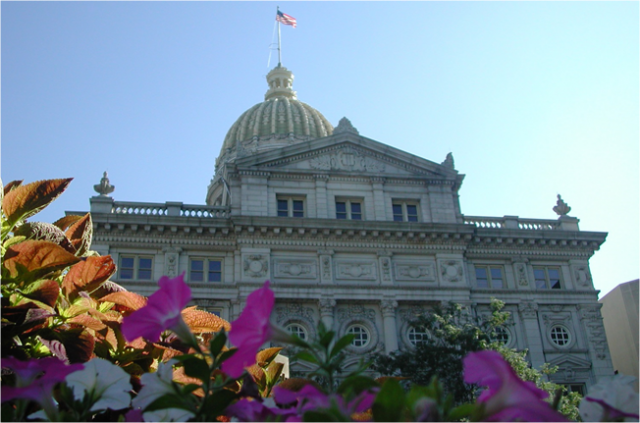
the erection of the present building. Westmoreland County Courthouse
The Westmoreland County Judges, the Board of County Commissioners, and
Westmoreland County Elected Officials welcome you to this historic
landmark... the Westmoreland County Courthouse. This magnificent
structure, described as one of the region's most beautiful Beaux Arts
buildings, is located on Main Street in downtown Greensburg, PA. Design
Erected in 1906, this four story imposing architecture can be seen from
several approaches into the county seat. It's central dome, 175 feet
above the ground, is of Italian Renaissance style, one of only two in
the world designed by the courthouse's original architect, William
Kauffman. Exterior The exterior walls are faced with light gray granite
from Maine. The massive central dome is flanked on either side by two
smaller ones above the main entrance, originally covered with ornamental
gold and ivory terra cotta. Roof edges and pediments are decorated with
stone banisters and ornamental carving and figures. The tympanum of
the front pediment is marked by sculpture in granite representing Art
and Industry under the protection of the Shield of the Nation. As a
crown are three female figures which can be seen from the main
thoroughfare facing east, they are symbolic of justice, the law, and the
people. On the face of the two large cartouches, between the main
entrance arches, are carved the Seals of the County and Commonwealth.
Interior The inside focal point of interest, is the 85 foot cupola, or
dome ceiling. Of Romanesque design, the rotunda in the center extends up
through four floors, reflecting light from four large semi-circular
windows at the base of the dome. The dome ceiling is painted with
delicate floral arabesques and gold leaf technique. Circular mezzanines
on each floor of the rotunda are balustraded in white marble.
English-veined Italian marble decorates the public hall walls as well as
the rotunda. Corridor floors and ceilings are laid with varicolored
mosaics. Panels are set with marble mosaics in Renaissance patterns. A
grand staircase of marble from the first floor opens upward to twin
spirals to the second floor. Two original courtrooms on the second and
fourth floors are enhanced by deep coved ceilings, colorful murals, and
Edwardian globular chandeliers. Saint Jago and San Domingo mahogany
complete the first and second stories while quartered oak enhances the
remainder of the building. French artist Maurice Ingres was
commissioned in the early 1900's to paint 15 wall and ceiling murals.
Oil paintings by the artist also include eight presiding judges who were
on the bench from incorporation to the time of the 1908, building
dedication and other founding fathers of the county. These portraits
appear on courtroom friezes within decorative plaster laurel wreaths
that favor classical French style, touches with gold leaf technique.
Court House Hours & Tours The courthouse may be visited weekdays
from 8:30 am to 4:00 pm. Group tours (15 to 35 people) may be arranged
in advance by calling (724) 830-3588. Location Greensburg is one hour
from downtown Pittsburgh via the Pennsylvania Turnpike; 1. Exit at Irwin
2. Follow Route 30 East to Greensburg
Person of Contact: Vicki Ali